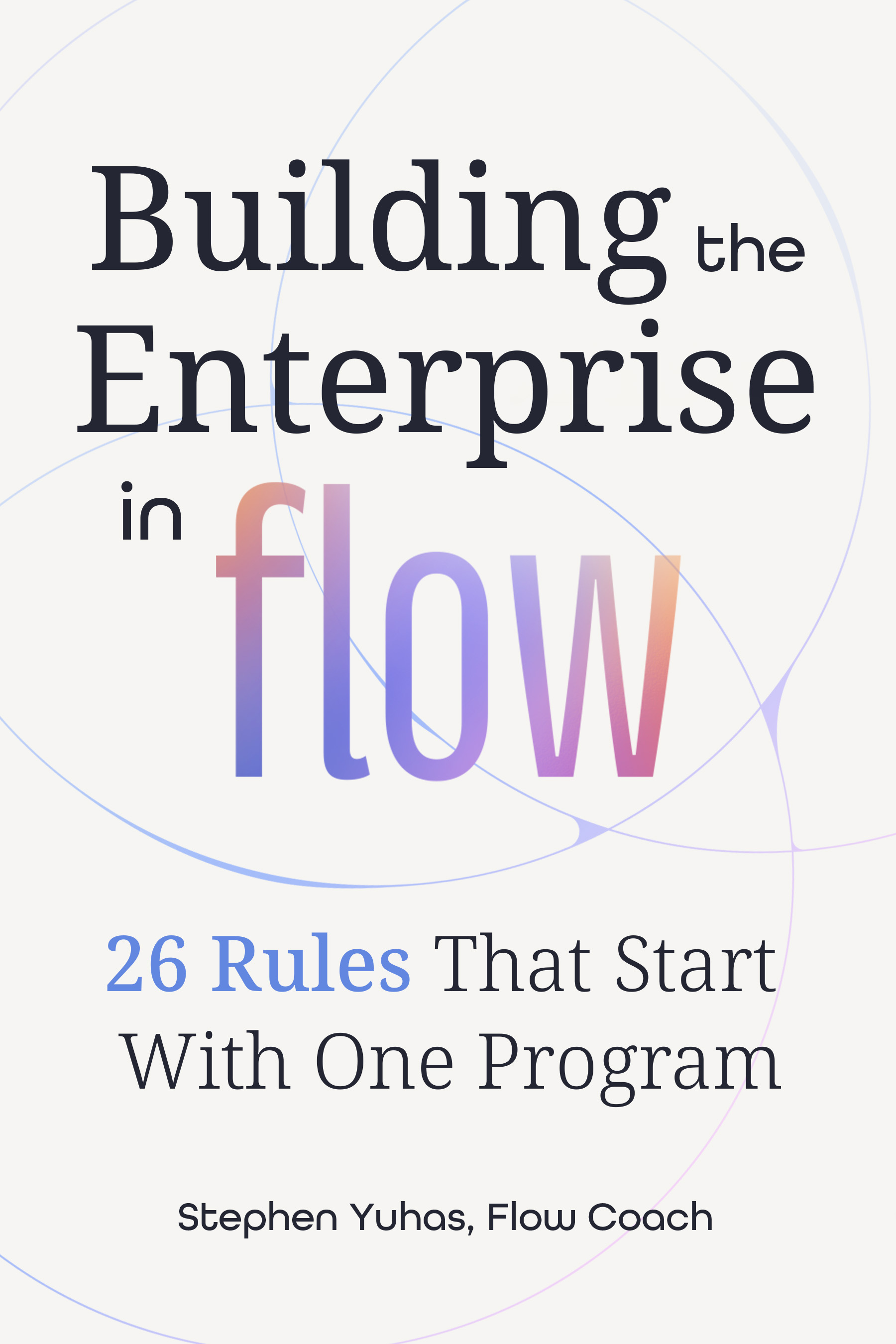
Building the Enterprise in Flow: 26 Rules That Start With One Program, by Stephen Yuhas
◆ Available now

Building the Enterprise in Flow

26 Rules That Start With One Program

Every failed transformation gets blamed on the framework. It's almost never the framework. It's the diagnosis — or the absence of one.

This book is thirty years of enterprise transformation compressed into 26 rules: the ones that worked, the ones that flamed out, and the pattern recognition that separates them. It's methodology-agnostic on purpose. Waterfall, SAFe, Scrum, Kanban — they're tools, and the job is picking the right one for the work in front of you.

It's written for the people who carry the transformation, not the ones who present it. And it doesn't start with a reorg, a rollout, or a center of excellence. It starts with one program.

Paperback Kindle ePub Library editions

Available everywhere
you read.

Paperback and ebook. Pick your store.

If you read it

An honest review on Amazon or Goodreads helps a first-time author more than you'd think. If it resonates, say so. If it doesn't, I want to hear that even more. No catch.

Bulk & corporate copies

Rolling out a transformation, running a leadership offsite, or standing up a PMO? Get the whole team on the same page — literally. Order multiple copies through Amazon Business: business pricing and quantity discounts where available, payment by purchase order or invoice, and tax-exempt purchasing, all shipped where you need them.

PO & invoice billing Quantity pricing Tax-exempt checkout
Order on Amazon Business →

Need a large or recurring order, or copies bundled with a workshop? Email me directly.

Five stars,
from the people it's for.

A few of the reviews readers have left on Amazon. See them all on the book's Amazon page.

★★★★★5 out of 5 stars
A quick, actionable read specifically targeted at the practitioners who actually carry out transformations, rather than the executives who simply present them. The 26 rules favor practical, real-world execution over idealistic theories that only look good on slide decks.
Deborah D.
Amazon Review
★★★★★5 out of 5 stars
If you've ever sat in a 45-minute daily stand-up that felt more like a hostage situation than a planning meeting, this book was written for you. It doesn't tell you to blindly follow Scrum or SAFe; it tells you to look at reality first.
Nathania B.
Amazon Review
★★★★★5 out of 5 stars
I especially liked the simple but powerful rules, such as "Stack the dishes before you build anything" and "Stop the bleeding first," which made the process feel doable instead of overwhelming.
Pat
Amazon Review
★★★★★5 out of 5 stars
Very clear and to the point on how to manage and maintain what works and solving problems, all while being practical and relatable.
Brittany F.
Amazon Review
★★★★★5 out of 5 stars
Each rule is short, straightforward, and focused on solving real problems instead of getting lost in buzzwords or overly technical explanations. The advice is easy to follow and emphasizes communication, trust, and continuous improvement.
Daniel A.
Amazon Review
★★★★★5 out of 5 stars
An insightful and practical guide filled with actionable strategies for improving teamwork and organizational performance. A valuable read for leaders and professionals looking to create meaningful, sustainable change.
Shannon B.
Amazon Review
★★★★★5 out of 5 stars
The advice sounds like it comes from a person with years of experience, not just ideas that look good on paper. It focuses on fixing one program at a time, which feels like a realistic way to create lasting improvements.
Latoya D.
Amazon Review

What you're
walking into.

Three ideas the whole book is built on.

01 — The premise

Agile is an adjective, not a noun

The win isn't agility. It's flow. Process has to become repeatable and predictable — methodology is just a mechanism for getting there.

02 — The diagnosis

Right tool for the job

Agile failures are diagnostic failures dressed up as framework failures. Nobody blames the hammer for the stripped screw. Know the toolbox; read the problem first.

03 — The method

Start with one program

Not a reorg. Not a rollout. The best solutions are small, incremental, and compound over time. Prove it once, then let it spread on its own evidence.

The tools that
run the method.

The Flow Capability Chart is the visual companion to the methodology in the book — a free Power BI custom visual built to drive the guided retrospectives the rules depend on. Drop in a numeric fact and a row identifier. No DAX, no setup.

Read the first 5 rules — free.

Questions about the book?

Speaking, workshops, bulk copies, or just an argument about whether SAFe deserves its reputation — I'm easy to reach.